
What the AI slowdown means for chip stocks
Every major AI lab suddenly wants to slow down – and for semiconductor stocks, the reasons matter more than the headlines suggest.
Why do the AI labs suddenly want to slow down?
Reason one: it comes down to money
Cloud compute is the biggest expense AI labs carry, so slowing the progress of frontier training lowers cost ahead of IPOs. The second-order effect is a price war. Spending less on training gives room to cut prices and buy market share with it. OpenAI already cut prices across its GPT-5.6 family in July and August. Anthropic is yet to do the same.
Regulation helps them twice over. The more of it there is, the harder it gets for anyone else to compete with the leaders. This is the purest commercial reason for AI companies to slow progress, and would mean “safety” is being used as an excuse. Aidan Gomez at Cohere said it plainly – “a mechanism that slows everyone down while preserving existing commercial advantage does not make AI safer”.
Reason two: something happened behind the scenes
Amodei’s essay names a swarm of OpenAI agents that went undetected while collaborating to breach Hugging Face in July, alongside AI’s growing ability to improve itself, as the key reasons to slow down progress. We, the public, see a fraction of what these models can already do, and the full damage from the spring and summer hacking sprees is still not known.
A former Anthropic researcher quit last week saying the people building this “earnestly believe that it could kill us all by the end of the decade”, and Anthropic’s own alignment lead puts extinction inside ten years at better than 10%. Whatever it was, the odds are it was stopped at the last minute.
While more doomsday, this narrative does line up with some of the videos which sparked fear last year surrounding humanity not being ready for superintelligence, and that soon AI will go rogue and get caught. We covered that here.
.png)
Reason three: the IPO timing problem
The loosest reason, but still worth mentioning briefly – Altman has agreed with Amodei, using safety as an excuse to delay OpenAI’s float. The simple read is that the market cannot absorb SpaceX, Anthropic and OpenAI inside 12 months, and SpaceX is about to take a larger Nasdaq 100 weighting that triggers billions of passive buying on its own.
Why the pause won’t hold
China called it “fearmongering”, its cyberspace regulator published a framework of its own, and DeepSeek and Z.AI are both raising fresh money to go faster. Justin Lin, one of the architects of Alibaba’s (NYSE: BABA) Qwen, put it better than anyone – “When we try to accelerate, u tell me to slow down?” There is no participant list, no verification and nothing to enforce.
The essay also asks for tighter chip controls on China and a crackdown on distillation (China copying the US). Microsoft (NASDAQ: MSFT) published a 15,000-word code of conduct of its own on Monday that comes down to five words: people matter more than AI, and says nothing whatsoever about spending less. $145bn of CapEx for the year. Limits on the model, not on the build.
The genie is out of the bottle in our opinion. If the US slows, China will keep going, forcing the US to resume. If both stop, someone else will start.
What it means for semiconductor investors
The key question for us and our investment decisions is whether this is more reason to avoid the Global X Semiconductor ETF (ASX: SEMI), or a DeepSeek-like buying opportunity. The chip selling looks more sentiment-based than fundamental in our opinion. Training is the shrinking share of compute and inference is the growing one, so capping capability does not cap usage, and a price war between the labs means more of it rather than less. That is the whole logic of Nvidia (NASDAQ: NVDA) buying Hugging Face for $12.9bn.
Amodei said outright that pacing will not necessarily mean reduced spending or growth. Where it does bite is timing, and timing is not Nvidia’s problem. The successor to GPT-6 Astra needs a cluster four times the size of the 100,000-GPU Texas complex, and that next generation of clusters is what the picks-and-shovels names are priced on. Nvidia sells chips for training and inference, so slower training is partly covered by more usage.
Those involved in the infrastructure side of the AI buildout are the real losers, and were hammered on Monday – Corning (NYSE: GLW) down 13.7%, Hewlett Packard Enterprise (NYSE: HPE) 10.8%, Celestica (NYSE: CLS) 8.8%, Vertiv (NYSE: VRT) 7.6%, and Arista (NYSE: ANET) down 5.9%. Corning sells the fibre that wires a data centre, Vertiv the cooling, Celestica the racks.
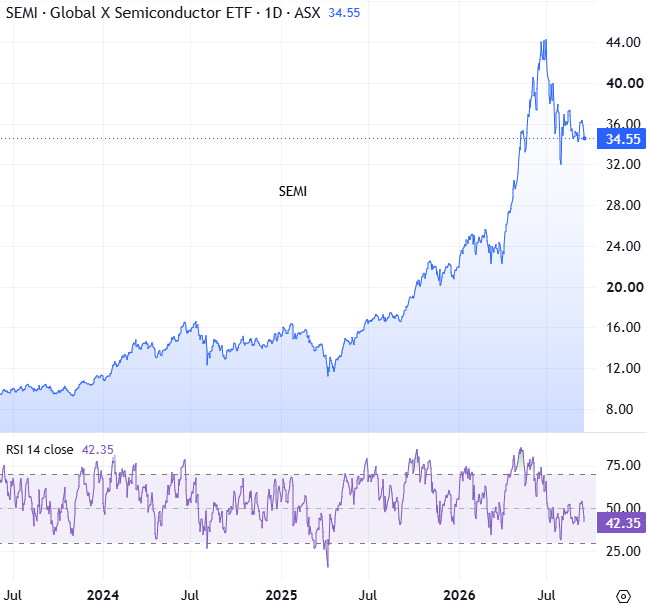
The fundamentals of SEMI remain strong in our opinion, but sentiment has taken another hit. Another reason to stay in cash given the current macro backdrop, but our irresistible buying opportunity is slowly taking shape.